Bishop Barron: Charlie Kirk died defending a tradition of truth-seeking

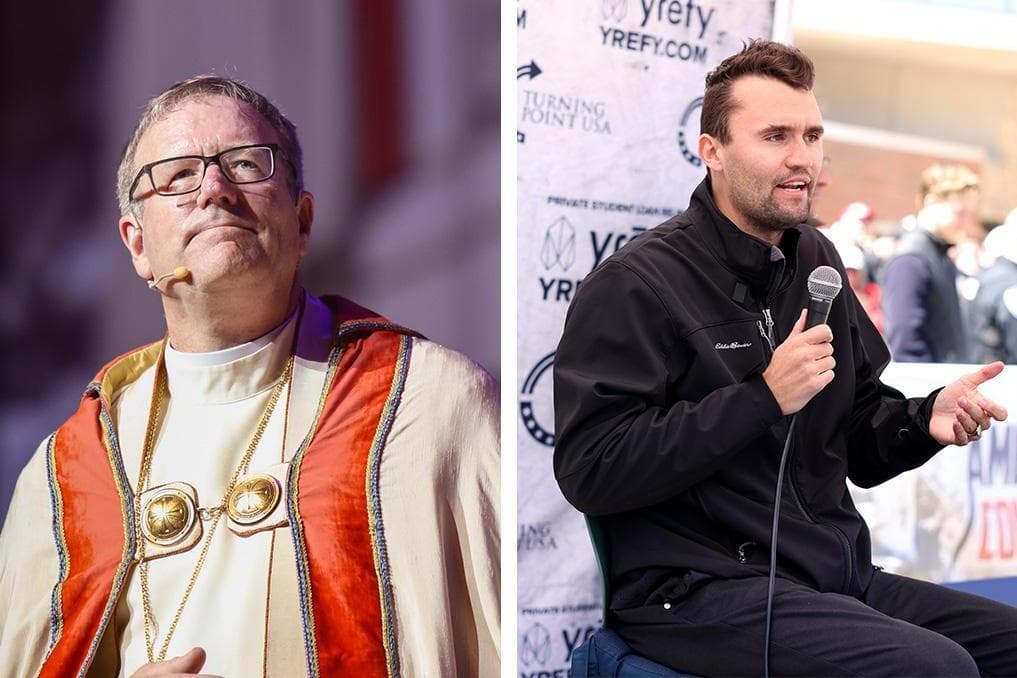
In an essay published Sept. 15 for First Things, Bishop Robert Barron reflected on the cultural weight of Charlie Kirk’s assassination, arguing that his death is significant not just for its tragedy, but because of how he died: with a microphone in his hand.
Bishop Barron sees Kirk’s public-facing, dialogue-driven approach as part of a long and noble tradition — and believes its violent rejection points to something deeply broken in modern culture.
Throughout the piece, Bishop Barron credited Kirk’s willingness to speak publicly with opponents, particularly on college campuses, as emblematic of a broader civilizational ideal.
“You’ll notice that he doesn’t duck hard questions and that he engages his interlocutors respectfully, even when he’s articulating a position radically contrary to theirs,” Bishop Barron noted. “Just a few months ago, I texted him with a word of congratulation after I saw him manage, with grace and a smile, an army of woke college kids who, to put it mildly, were pretty obnoxious to him.”
The bishop connected Kirk’s style of engagement to the foundations of both Western civilization and Christian intellectual tradition. Drawing on the example of Socrates, Plato, Aristotle, and St. Thomas Aquinas, Bishop Barron described a vision of learning and truth-seeking rooted in conversation, argument, and the pursuit of shared understanding.
“This tradition of truth-seeking through conversation thoroughly conditioned our Founding Fathers,” he added, “who built an entire political system on dialogue, debate, and freedom of speech.”
But for that tradition to survive, according to Bishop Barron, two essential beliefs must remain in place: the dignity of the human person and the objectivity of truth. When either is lost, argument gives way to force. He pointed to the horrors of the 20th century — Hitler, Mao, Stalin — as evidence of what happens when human dignity is denied.
“[I]f one holds to the intrinsic value of each human being,” he wrote, “one will use words rather than guns, arguments rather than threats.”
Both beliefs, the bishop continues, depend on something even more fundamental: belief in God. Without God, he warned, the philosophical foundation for human dignity and moral objectivity collapses.
“We revere the individual human being because we are convinced, consciously or unconsciously, that he or she is a beloved child of God,” he wrote.
When that religious foundation disappears, the consequences are real and destructive.
“What happens is that the conditions for the possibility of civil conversation are fatally compromised,” Bishop Barron said.
He sees Kirk’s assassination — and the disturbing online celebration of it — as a symptom of this deeper moral crisis.
“I don’t care how dramatically you might disagree with someone; if you celebrate his murder, you have lost any sense of the dignity of that person,” he said.
The bishop also sees a link between rising support for political violence and declining religious practice. When people stop going to church, he argued, they lose the moral framework that supports empathy, justice, and peace.
Without prayer, Scripture, or the ethical teachings of faith, “people stop believing that their brothers and sisters should be cherished and that a morality beyond the clash of wills is possible,” he said.
Ultimately, Bishop Barron presented Kirk as someone who, up to his final moment, was practicing the very kind of reasoned, faith-infused discourse that once defined the best of Western civilization.
“We sense that something basic to our civilization, something axiomatic and fundamental, is teetering — and that truly fetid cultural influences have found their way into our institutions and the minds of our kids,” he concluded. “My sincere hope and prayer is that we can take renewed inspiration from a courageous and religious man who died, not with a gun in his hand, but rather an instrument of communication.”