Boston archdiocese offers Valentine’s Day convalidation ceremony for civilly married couples
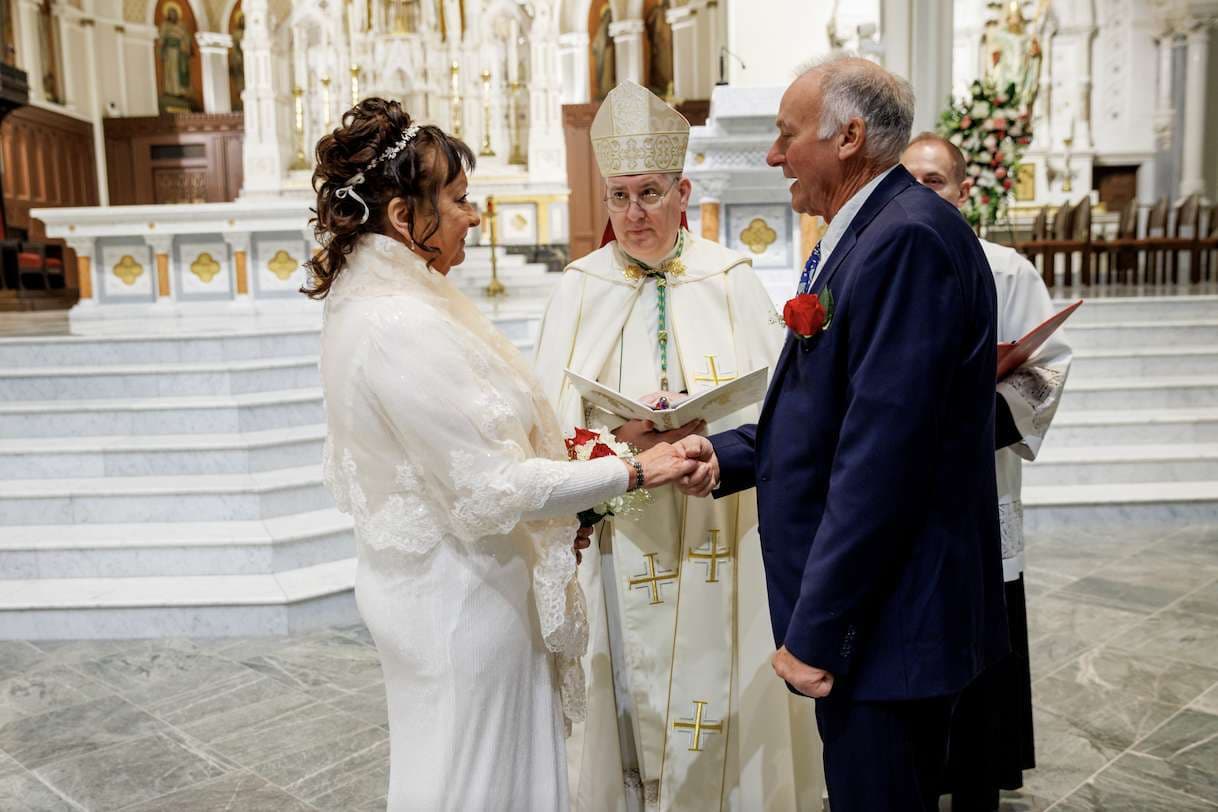
On Valentine’s Day, about two dozen couples will gather at Boston’s Cathedral of the Holy Cross to enter the sacrament of marriage through a convalidation ceremony. The couples — some newly married, others together for decades — were previously married solely civilly.
The annual ceremony, now in its third year, reflects a broader effort by the Archdiocese of Boston to raise awareness about convalidation, a process many civilly married Catholics could undergo.
“We’ve decided here as an archdiocese that we wanted to grow the awareness of convalidation, because I think there's a lot of people out there that don't even know that it exists,” Liz Cotrupi, the archdiocese’s Director of Family Life and Ecclesial Movements, said in an interview with CatholicVote.
The effort is designed to make the process visible and accessible to couples across the archdiocese.
“We want to do everything we can to help couples who are not married in the eyes of the Church become married in the eyes of the Church,” Cotrupi said. “We want couples who have been married civilly to understand how much God wants to bring them fully into the faith and have His grace and the support of the Church for their sacramental marriage.”
A sacrament many didn’t know they were missing
Convalidation is the process by which a couple’s civil marriage becomes a sacrament in the Church, though awareness of the practice remains limited. Many couples assume that because they are legally married, regularly attend Mass, or are raising children in the Church, they are already fully participating in sacramental life.
Often, they learn otherwise only at moments of joy or responsibility: when asked to be a godparent, when preparing for a child’s baptism, or when returning to the Church after years away.
“People get caught off guard,” Cotrupi said, but noted that the moment often becomes an opportunity to invite couples to consider receiving the sacrament of matrimony and to learn more about the grace it offers.
Cotrupi said many civilly married Catholics do not realize how their marital status affects their participation in other sacraments.
“The other thing is, I don't think people who are civilly married realize if they're attending Mass they're not really supposed to receive the Eucharist.” she said. “So there's a variety of reasons.”
Rather than approaching those situations as obstacles, she said, the archdiocese sees them as pastoral openings.
“Our job as diocesan leaders is to help share the beauty of the sacrament and the information about it, so people can then make their own decision.”
An effort that began locally
The idea for the annual convalidation ceremony grew out of earlier pastoral efforts led by Bishop Mark O’Connell, who offered group convalidation ceremonies while serving as an auxiliary bishop in Boston. When he later became vicar general, he asked diocesan leaders if they could expand the effort across the entire archdiocese .
Rather than promoting the ceremony itself, Cotrupi said the archdiocese focuses on making information about convalidation available through parish mailings, social media, and its evangelization website.
“Knowledge can be empowering,” Cotrupi said. “Sometimes they just don't understand why, like ‘Why would I want to have my marriage convalidated?’ And that's kind of why we're here, to support the parishes, to get that information out as to, you know, ‘why?’”
Couples are encouraged to speak first with their pastor, deacon, or parish staff, and can then choose to convalidate their marriage at their parish or at the archdiocesan ceremony.
This year, the archdiocese hopes to convalidate about 25 couples.
“That’s not a huge number for a large archdiocese,” Cotrupi said. “But what we’re finding is that it’s provoking parishes to put something out about convalidation in their bulletins, and more people are getting it done at their parish.”
She added that some pastors have even begun offering group convalidations at the parish level as a result.
“That was really the goal,” she said. “The push was to grow awareness about convalidation.”
Marriage as a source of grace
At the heart of the archdiocese’s approach to convalidation is a desire to help couples encounter marriage as a source of grace meant to sustain them over time.
Cotrupi said her office works with couples through marriage preparation, enrichment programs, retreats, and support for separated or divorced couples, all of which emphasize the Church’s understanding of marriage as a lifelong covenant strengthened by God’s presence.
“We want people to understand what comes from the sacrament of marriage and how that can strengthen and enhance their marriage,” she said.
The archdiocese’s materials emphasize marriage as a covenant sustained by grace, often invoking the biblical image from Ecclesiastes: “A threefold cord is not easily broken.”
“When you put God in the center of your marriage, there’s strength that comes from that,” she said, pointing to the grace of the sacrament and the support that accompanies it.
The goal is not to persuade couples but to present a fuller vision of what the Church believes marriage is meant to be, Cotrupi said — one that shows “there’s something more.”
‘Never too late’
Cotrupi acknowledged that in some cases, couples may need to address prior marriages or other complications. But she stressed that most of the time, couples discover the process is far less daunting than they expected. The first step is typically a conversation at the parish level, not a commitment to proceed.
“Just go and talk to somebody at your parish — the pastor, a deacon, or a pastoral associate — and say, ‘I want to learn more about the sacrament of marriage. How is this going to help us? Why should we go through this?’” she explained.
Even so, many couples hesitate simply because they assume the moment has passed, they’ve been married for years, or they feel overwhelmed or worry it is “too late.”
However, Cotrupi said it’s never too late, adding, “We’ve had couples come who have been married 30 or 40 years and say, ‘I never knew this was available.’”