Justice Amy Coney Barrett gives rare interview discussing Constitution, court trust, national division

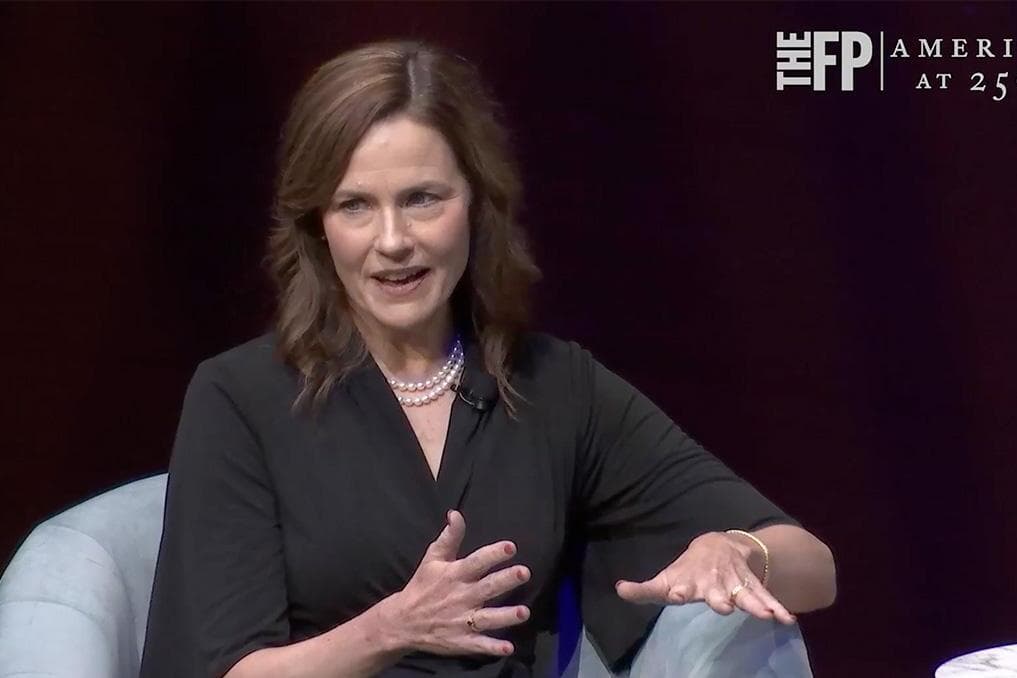
In a rare public interview hosted by The Free Press at Lincoln Center, Supreme Court Justice Amy Coney Barrett addressed the state of the Constitution, historical tensions between the judiciary and the presidency, and the internal culture of the Court following the Dobbs leak.
Barrett, appointed in 2020 at the age of 48, acknowledged her unique path to the Court — coming from Notre Dame Law School rather than the Ivy League, and entering with a primarily academic background.
She said little about the contentious confirmation process that accompanied her appointment, but her comments throughout the interview made clear that she sees the work of a justice as fundamentally nonpartisan.
When asked whether the country is in a constitutional crisis, Barrett was clear: “I think the Constitution is alive and well,” she said, later adding, “I think that our country remains committed to the rule of law. I think we have functioning courts. I think a constitutional crisis would clearly be one in which the rule of law crumbled.”
She acknowledged the country’s divisions, but framed them in historical perspective. From the Vietnam War era to the Civil Rights Movement, America has endured fierce internal strife.
“We’ve had times in this country where we have been bitterly divided, and we have come out stronger for it,” she noted.
Asked about President Donald Trump’s suggestion that “rogue judges” might be defied, Barrett didn’t reference him directly, but contextualized the moment within a long history of presidential clashes with the judiciary.
She pointed to Andrew Jackson, Abraham Lincoln, and Franklin D. Roosevelt as examples, noting, “This is a dance that we’ve seen before.”
On the leak of the Dobbs decision in 2022, which overturned Roe v. Wade, Barrett said it was “shocking” and “a huge breach of trust.”
Describing the Court as a close-knit institution where justices and staff refer to one another as a “family,” she admitted the leak altered internal dynamics.
“I personally have worked hard not to let it change or make me paranoid, change the way that I relate, because I think one of the beautiful things about the way that the court operates is the trust that we have,” she said. “But, you know, you’re looking over your shoulder.”
Barrett has been described in the press as both a conservative crusader and, more recently, the “last best hope” for liberals on the court. She brushed off those labels.
“Judges wear black robes because we are not partisan,” she said. “We’re not wearing red and blue robes.” The left-right lens, she added, is “just the wrong way to think about the law.”
Zeale News reported that Barrett recently published a memoir Listening to the Law: Reflections on the Court and Constitution, where she considers the intersection of faith, conscience, and the rule of law. Rejecting the idea that religious belief disqualifies one from impartial judgment, she pointed out that moral conviction is a universal human reality — religious or not.
“Fortunately for the health of our country,” she wrote in her book, “People of faith are not the only Americans with firm convictions about right and wrong.”