Meet the siblings who painted St. Carlo’s encounter with the Blessed Mother

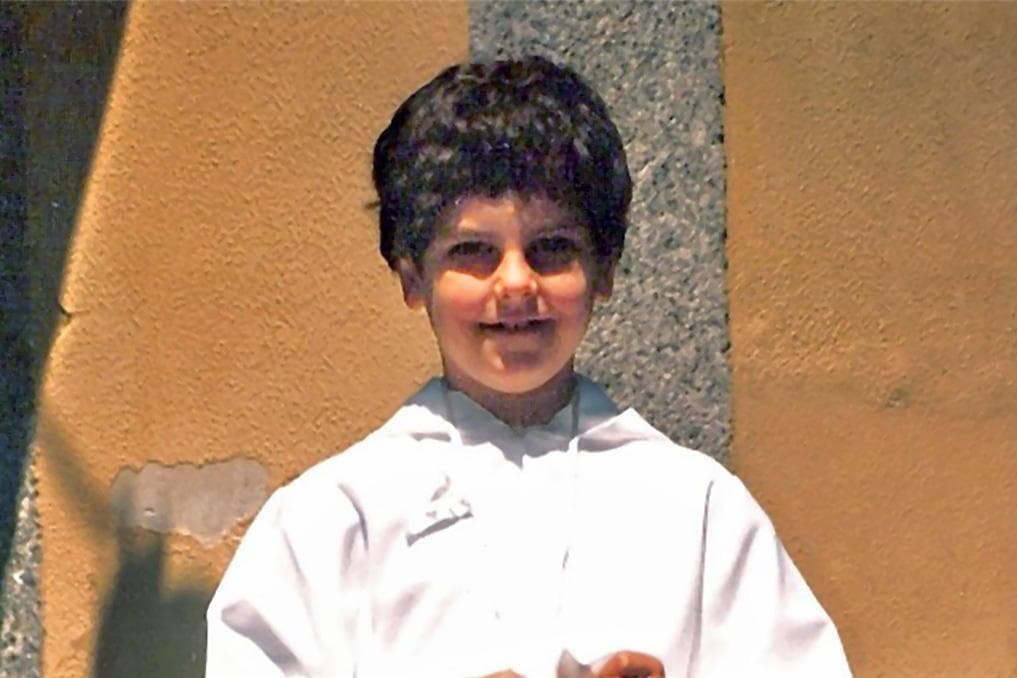
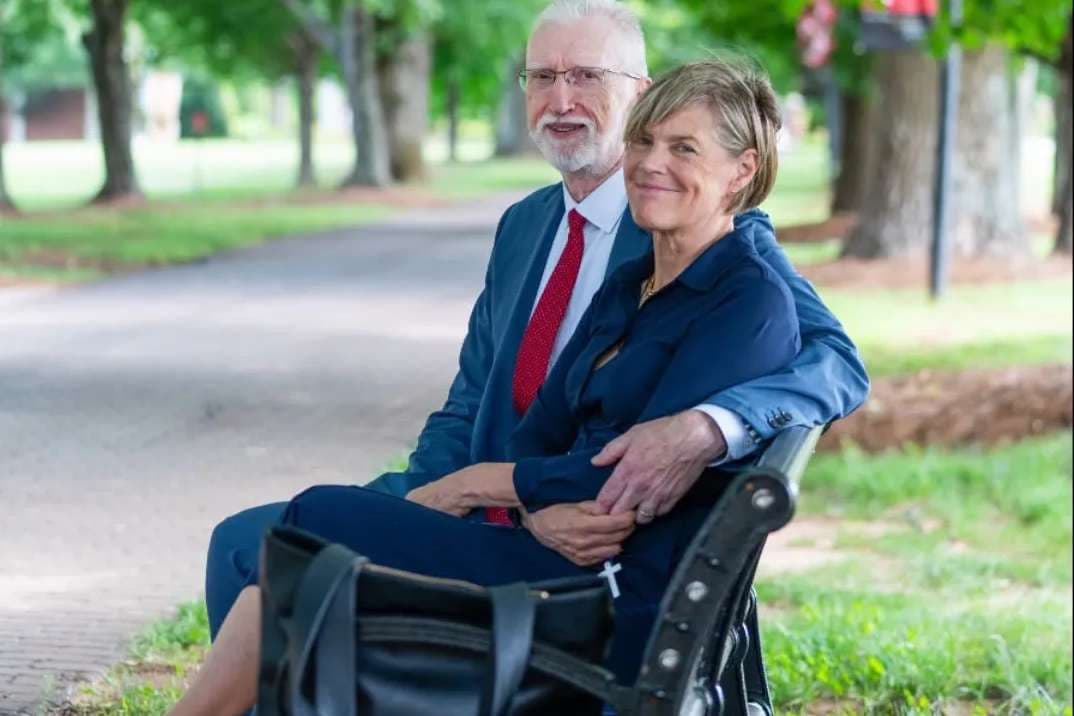
St. Carlo Acutis, the first millennial saint, was canonized Sept. 7. While much of the artwork of St. Carlo emphasizes his relatability, depicting him in a polo, siblings George Capps and Polly Capps Paule went a different route: They depicted him as a child in a mystical encounter with the Blessed Mother.
George Capps wrote to CatholicVote in an email interview this week about the commission for the unique artwork of the saint, the inspiration behind the painting The Consecration of Carlo Acutis, and the role of sacred art.
CatholicVote: You were commissioned to create a painting of St. Carlo Acutis. Could you describe the process of receiving the commission and the inspiration behind the painting?
Capps: In early 2025, we were approached by the founder of the Real Presence Education Foundation, a not-for-profit organization dedicated to promoting belief in and devotion to the Real Presence of Christ in the Eucharist via programs in Catholic schools and parishes. The organization’s leaders leveraged a lot of Carlo Acutis’s work on Eucharistic miracles in their presentations, and they were planning a new parish-based ministry focused on family consecration to the Immaculate Heart of Mary through Carlo’s intercession. This was inspired by a passage in his mother’s recent book, in which she revealed that around the time of his First Communion Carlo received a vision of Our Lady of Fatima offering him her heart.
The foundation was looking for an image of this scene to serve as the visual branding for the ministry’s marketing and as cover art for the instructional materials.
CV: Did you have a devotion to St. Carlo previously?
Capps: While we had certainly heard of St. Carlo, we didn’t know much about him until receiving this commission. A standard part of our compositional process is a deep dive into the written sources and documentary evidence pertaining to our subject, and getting to know Carlo, along with his intense but profoundly accessible spirituality, was one of the special joys of this project.
CV: Your website mentions that while you embrace progress, you also value the importance of continuity with the past. How do you strike the balance of creating new art that both engages modern audiences and honors the Church’s tradition of sacred art?
Capps: We strike a balance by creating works that represent an organic development of the tradition stream. In so doing, we avoid the extremes of either copying a particular past style or making a radical break from the tradition.
If you look back at the history of Christian art, it’s easy to see how succeeding generations built upon the work of previous centuries, culminating in the great Counter-Reformation masterpieces at the height of the Western Church’s patronage of the arts. Then, in the 18th and 19th centuries, the art world started going in a very different direction, the Church ceased to be a major player on the cultural stage, and that sense of continuity was broken. We try to pick up where the late Baroque tradition of the early 1700s left off, not adopting that style wholesale but using it as the starting point for honing our own unique artistic voice.
We honor the Church’s heritage by carefully studying the works of the Old Masters and understanding the theological and aesthetic principles underlying their iconographic approach. We then fully embrace what is timeless in those principles and bring it to bear in our own artwork. On the theological side, this includes, for example, creating sacred artwork that is representational enough to be legible, abstract enough to be universal, and idealized enough to have an eschatological dimension. On the aesthetic side, it means, for example, incorporating what Aquinas defined as the three elements of objective beauty: wholeness, harmony, and clarity of form.
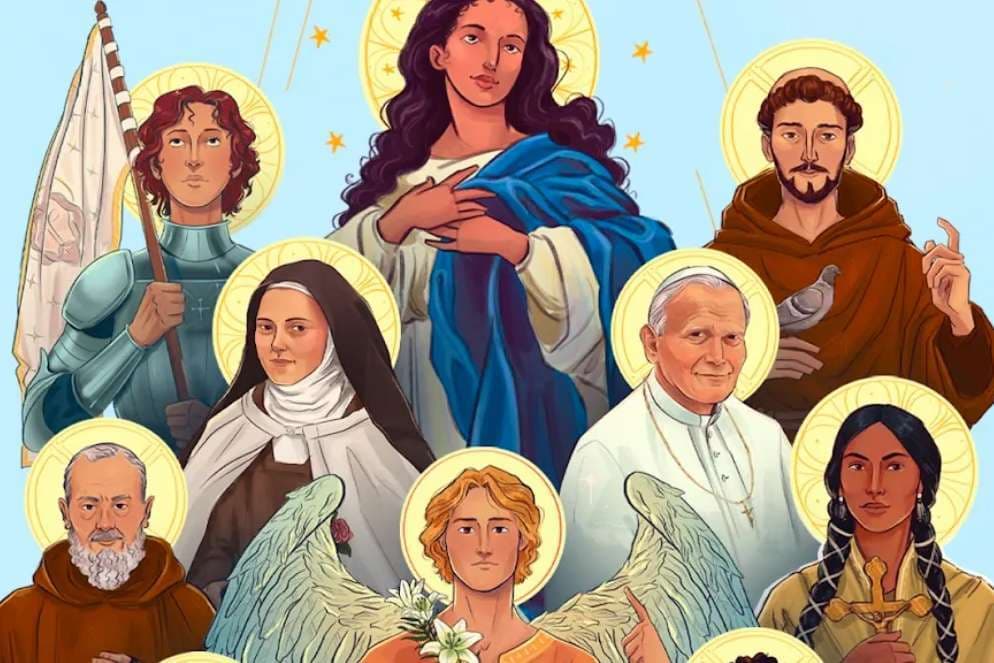
Meanwhile, we engage modern audiences by depicting saints from modern times (such as Carlo Acutis and John Paul II); grappling with themes that are germane to contemporary society (such as truth vs. relativism, human dignity and social justice, multiculturalism, the allure of atheistic collectivist ideologies, etc.); and developing a style with enough visual impact and technical sophistication to cut through the sensory noise of our image-saturated culture.
CV: How did you become involved in sacred art?
Capps: We can identify three factors. First, we take a lot of our artistic inspiration from the great religious works of the Counter-Reformation era, so it’s natural for us to be drawn to sacred subjects.
Second, we desire to glorify God through the gifts that he has given us, and sacred art, being explicitly focused on worship, is an especially direct means of doing so. We feel called to evangelize the culture, and we think that the first step in evangelizing the culture is to make our churches havens of beauty.
Third, there was market pull. For years before we founded Goretti Fine Art, I had been getting unsolicited commissions to paint religious scenes. I came to realize that there was a hunger for authentic beauty in the life of the Church and that this need was going unmet.
CV: Could you explain the relationship between sacred art and prayer? And how does that differ for the artist and the person viewing the art?
Capps: There is an intimate relationship between sacred art and prayer. For the artist, having an active prayer life is absolutely essential to the process. Prayer purifies the imagination and informs the creative vision. By developing a relationship with God through prayer, we can begin to perceive in created things a glimmer of their divine source. Drawing that glimmer out and helping to communicate it to others is precisely the artist’s job.
Without this aim, art devolves either into abstract expressionism, where the only truth is one’s own subjectivity, or into “hyperrealism,” which is effectively a denial of any higher reality beyond the material plane. Authentically Christian art, on the other hand, is fundamentally representational but also points beyond itself to an invisible, transcendent truth. The vocation of the Catholic artist, therefore, is to represent sensible things in a way that communicates the deeper spiritual realities that lie behind them.
When you put it that way, you can understand how art and sacramentality go hand-in-hand and why it was so wrong-headed for the liturgists of the mid-to-late twentieth century to banish figurative artwork from our churches on the theory that it somehow distracts from the liturgy. Quite the contrary—when done right, sacred art synergizes with the sacraments.
And that brings us to the viewer. By communicating spiritual truth through the senses, sacred art serves to inspire a sense of awe at the transcendent mysteries of the Christian worldview. In the context of the Mass, liturgical art operates in tandem with the rituals and other sensible sacramental elements, helping to make the viewer keenly aware of this Divine presence and fostering a sense of belonging with the larger community of saints and angels, that “great cloud of witnesses” (Heb 12:1) of which the sacramental participant has become a part. Sacred art, in short, is designed to make the onlookers aware that the barriers of time and space have fallen away and that they are united with the faithful of past, present, and future in an act that transcends natural limitations.
Meanwhile, outside the context of the Mass, religious art that is devotional in character is designed to inspire personal piety and meditation by drawing the viewer into an intimate personal relationship with Christ, sometimes via interior conversation with His Blessed Mother or another saint.
In summary, just as all creation flows from God and is directed back to God, so it is with sacred art: a relationship with God in prayer is the source of the creative process from the artist’s perspective, and it is the end goal of the creative process from the viewer’s perspective.
CV: What inspired you and Polly to found Goretti Fine Art?
Capps: We knew that we had aligned creative vision and complementary skill sets, and we felt called to use the gifts that God had given us to evangelize the culture through beauty. We had talked about the possibility of joining forces for some years. Then, right around the time that Polly was finishing her fine arts degree and completing her training, I was at a point in my professional development where a career transition seemed appropriate. So we decided that the time was right to take the plunge and found the studio. We’re blessed to have been busy with original commission work ever since!
Note: this interview has been edited for brevity and clarity.