Scotland bishops denounce law barring pro-life speech near abortion facilities as grandmother is charged with violation
The Catholic bishops of Scotland are speaking out against an unprecedented “buffer zone” law criminalizing pro-life speech near abortion facilities in the country, warning that the law “represents state overreach and curtails basic freedoms.”

The Catholic bishops of Scotland are speaking out against an unprecedented “buffer zone” law criminalizing pro-life speech near abortion facilities in the country, warning that the law “represents state overreach and curtails basic freedoms.”
Their Jan. 6 message comes as the first charge of a buffer zone violation has been issued — against a 75-year-old grandmother — and amid the Christmas season; a holiday, the bishops noted, that underscores the fragility of infant human life and Christians’ obligation to protect it.
“At Christmas, Christians across Scotland gathered around the crib to contemplate the life of a vulnerable child; God entering our world as a baby in need of care, protection and love. Christmas places fragile human life at the centre of everything,” the bishops said.
“It is therefore unsettling that this season saw the first person in Scotland charged under the new so-called ‘buffer zone’ law in Scotland; a law the Church believes curtails Scotland’s commitment to freedom of expression and conscience,” the bishops continued, “and restricts critical voices from democratic debate in the public square.”
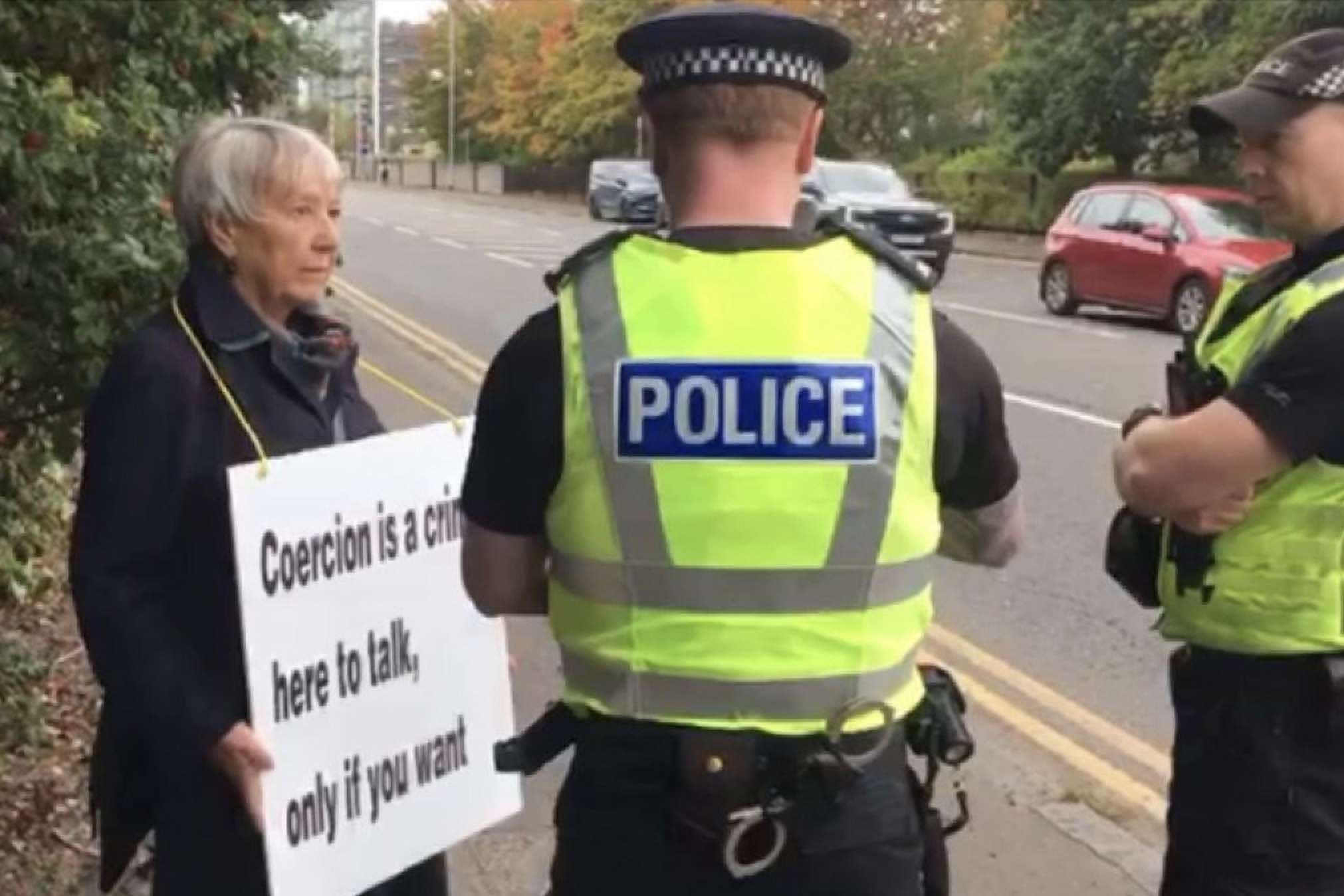
According to Alliance Defending Freedom International and a Dec. 19 BBC report, Rose Docherty was recently charged with breaching the buffer zone after she held a sign — once in May and once in September 2025 — that said “Coercion is a crime, here to talk, only if you want,” outside an abortion facility. Police arrested her on both occasions.
The bishops’ press release title described the holiday season as “a chilling Christmas for freedom of conscience in Scotland.”
The “buffer zone” law, known as the Abortion Services Act 2024, prohibits pro-life speech within or up to 200 meters (about 656 feet) of abortion facilities. According to the bishops, the law can criminalize any conduct that is determined to “influence” a decision about abortion within those zones.
The law’s vague description, the bishops said, “should trouble anyone who values legal clarity or free expression.”
The bishops emphasized that the Catholic Church is opposed to harassment and intimidation and that Scotland already has laws against public disorder and harassment, so this “buffer zone” law does not offer new protections on that front.
“When parliaments introduce criminal offences where existing law is already sufficient, questions should be raised and alarm bells ring,” the bishops said. “We oppose this law because it is disproportionate and undemocratic. It represents state overreach and curtails basic freedoms.”
The bishops added that the Church would speak out similarly if there was a law establishing a buffer zone outside nuclear weapons facilities or refugee detention centers.
The law criminalizing pro-life speech has a further reach, too, the bishops warned: It extends to regulating the actions of those living in homes within the buffer zone. Pro-life posters in a window, an overheard conversation, or a prayer raised near a window, all could be criminalized under this law, in principle, they said.
In February 2025, Green party MSP Gillian Mackay, the author of the “buffer zone” legislation, noted that praying near a window could constitute an offense, saying that it “depends on who’s passing the window.”
The bishops said this statement “sends a chill down the spine of anyone who cares about civil liberties. Criminal law that depends on the perception of a passer-by is certainly not the hallmark of a free Scottish society.”
A perceived silent pro-life prayer within the zone could also be criminalized under this law, the bishops warned, adding that a number of Scottish police have expressed concern about enforcing it. The bill also does not allow exemptions for chaplains offering a pastoral conversation.
“We support all those who, motivated by conscience and compassion, stand up for the right to life. It cannot be a crime to give our voice and our prayers to the unborn,” the bishops said. “Christmas is the message that every human life has infinite dignity from its beginning. That truth is not confined to private thoughts. A society confident in its values does not fear opposing voices. It does not criminalise silent prayer. It does not ask its police or judges to peer into the minds of its citizens.”
This law marks a major change in the relationship between the state and the citizen, restricting freedom of speech and religion, the bishops warned.
“As we look to the child in the manger this Christmas and Epiphany, we are reminded that babies do not have a voice of their own,” they said. “It is a shame that the State has now also curtailed the voices of ordinary citizens who advocate for them within its borders.”